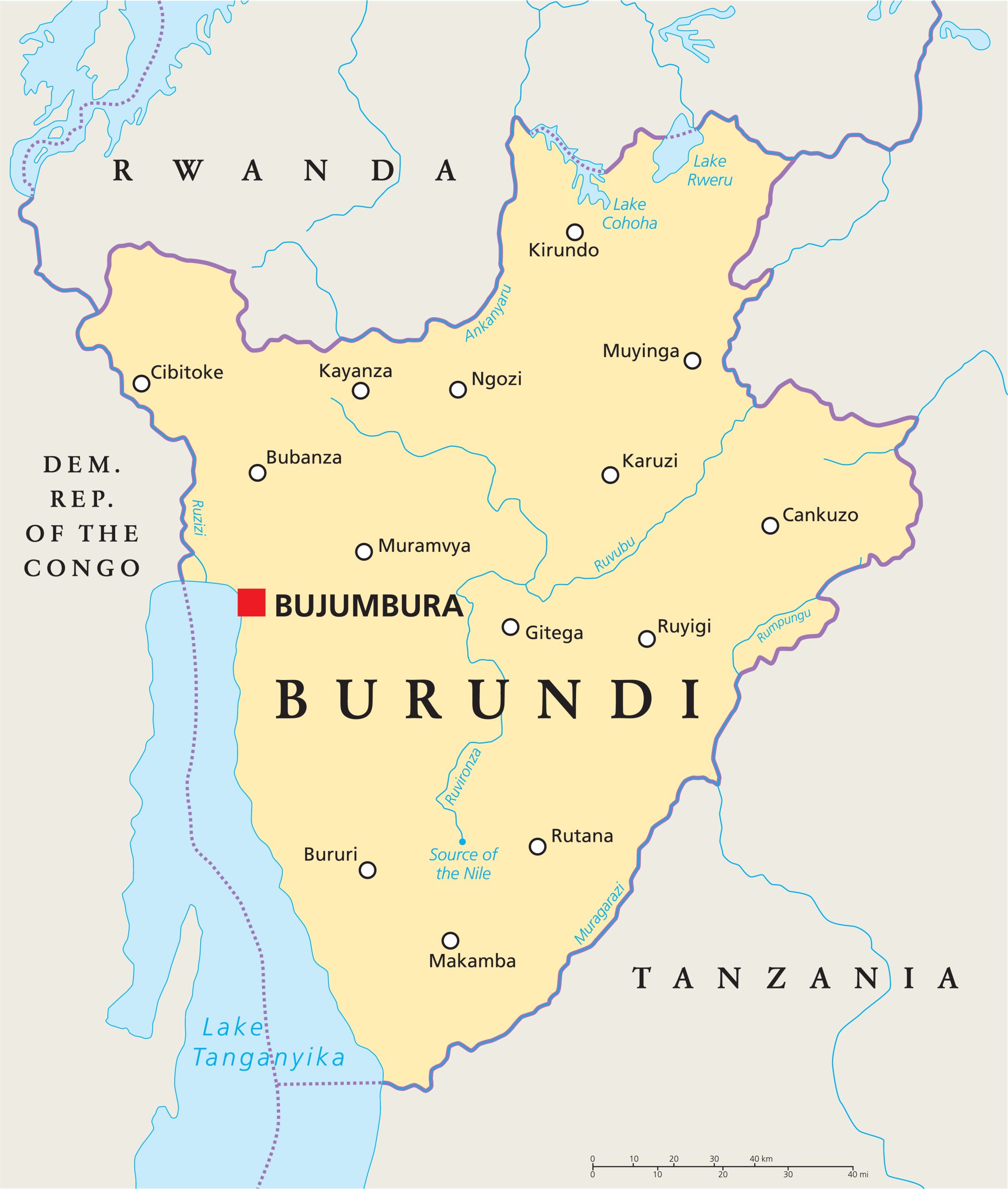
Burundi is a landlocked country located in the heart of Africa, nestled between Rwanda to the north, Tanzania to the east and south, and the Democratic Republic of the Congo to the west. Lake Tanganyika forms its southwestern border.
Here’s a closer look at Burundi’s geography:
- Landlocked: Burundi has no coastline, being roughly 1200 km from the Indian Ocean and over 2000 km from the Atlantic Ocean.
- Area: Burundi is a relatively small country, with a total area of 27,830 square kilometers (10,750 sq mi), of which about 25,680 square kilometers (9,920 sq mi) is land.
- Topography: The terrain of Burundi is quite diverse, consisting of:
- Mountains and Hills: A chain of mountains and high plateaus formed from ancient Precambrian rock dominate the western half of the country. The highest point in Burundi is Mount Heha, reaching 2,684 meters (8,806 ft) above sea level.
- Congo-Nile Divide: Burundi straddles the crest of the Congo-Nile Divide, which separates the basins of the Congo and Nile rivers. The source of the Nile’s farthest headwater, the Ruvyironza River, can be found in Burundi.
- Eastern Plateaus: The eastern regions have a plateau landscape, gradually descending towards Tanzania.
- Lake Tanganyika: Bordering the southwest is the massive Lake Tanganyika, one of the deepest lakes in the world. Burundi’s lowest point is at the lakeshore, at 772 meters (2,533 ft) above sea level.
- Climate: Burundi has a tropical climate with a moderate altitude variation. Temperatures are generally mild, averaging around 19 °C (66 °F) throughout the year. The country experiences a wet season from February to May and a dry season from June to January.
The History of the Burundian Coffee
Burundi’s coffee cultivation has a relatively recent history, marked by a shift from colonial influence to a more independent market:
Colonial Introduction (1920s-1960s):
- Belgian Colonization: In the 1920s, Belgian colonial rulers introduced Arabica coffee plants to Burundi.
- Forced Cultivation: By the 1930s, the Belgians mandated coffee growing for Burundian farmers, providing minimal support or resources.
Post-Independence (1960s-Present):
- Brief Privatization: Following independence in 1962, Burundi experimented with a private coffee sector for about a decade. However, quality and production suffered due to political instability.
- State Control & “Ngoma Mild”: By 1976, the government took control of the coffee industry. Coffee was sold as a bulk commodity called “Ngoma Mild” (Ngoma being a traditional drum), with little focus on individual farm quality.
- Liberalization & Emphasis on Quality: In recent decades, Burundi’s coffee market has undergone liberalization. This has allowed for a focus on higher quality coffee production and processing methods like double fermentation/washing.
Current Landscape:
- Smallholder Farmers: Burundi’s coffee production is dominated by smallholder farmers, with over 700,000 families involved. These farms typically have a small number of trees (50-250).
- High Altitude & Bourbon Variety: Coffee grows at high altitudes (1250-2000 meters) and is primarily the Bourbon variety, known for its complex flavors.
Challenges and the Future:
Despite its potential, Burundi’s coffee industry faces challenges like limited infrastructure and reliance on world market prices. However, efforts are underway to improve processing techniques, farmer training, and access to specialty markets, leading to a brighter future for Burundian coffee.
Burundi Tourism
Burundi, a small, landlocked country in the heart of Africa, offers a unique and unforgettable tourist experience. While it may not be the most visited country, Burundi’s stunning scenery, rich cultural heritage, and friendly people make it a hidden gem for those seeking an off-the-beaten-path adventure.
Here are some of the highlights of Burundi tourism:
- Spectacular Landscapes: From the majestic mountains and rolling hills of the central highlands to the vast expanse of Lake Tanganyika, Burundi’s natural beauty is breathtaking. Hikers can explore the Kibira National Park, a UNESCO World Heritage Site, home to chimpanzees, monkeys, and a variety of birdlife. Take a boat trip on Lake Tanganyika, the second deepest lake in the world, and explore the Rusizi National Park, a haven for wildlife such as hippos, crocodiles, and a variety of birds.
- Rich Cultural Heritage: Burundi has a fascinating cultural heritage, with ancient traditions still practiced today. Visitors can experience the rhythm of Burundian drums, an integral part of their culture, and witness the intricate dances performed during ceremonies. The country is also home to a number of historical sites, including ancient royal tombs and traditional villages.
- Warm and Welcoming People: Burundians are renowned for their hospitality and warmth. Visitors are sure to be greeted with smiles and friendly conversation.
- Coffee Experience: Burundi is a major producer of high-quality Arabica coffee. Visitors can tour coffee plantations, learn about the traditional brewing process, and sample a cup of this delicious coffee.
Burundi may be a small country, but it has a lot to offer visitors. With its stunning scenery, rich culture, and friendly people, Burundi is sure to leave a lasting impression.